How to Use a Flipped Classroom Model in High School Language Arts
What is a flipped classroom?
Why yous should flip your classroom?
How to implement a flipped classroom?
What has recent enquiry on flipped classroom and medical education suggested?
What is a flipped classroom?
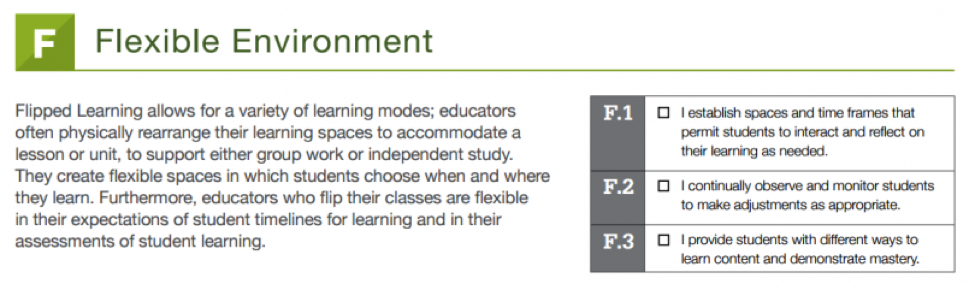
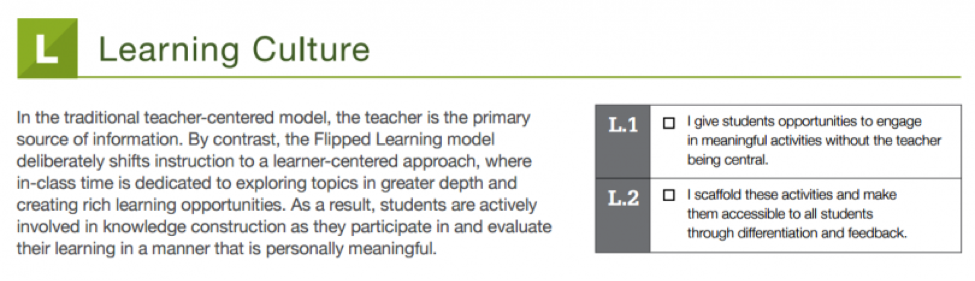
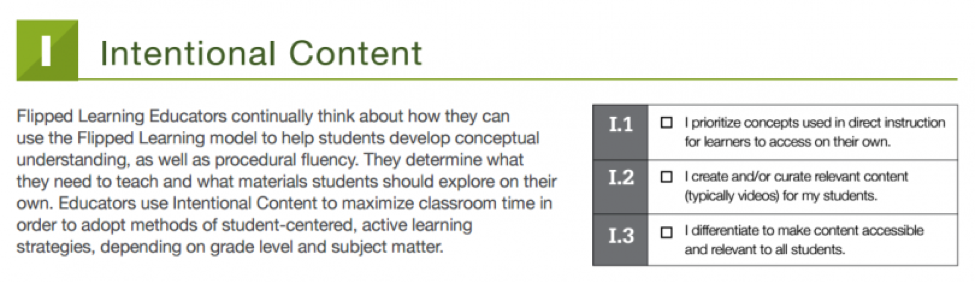
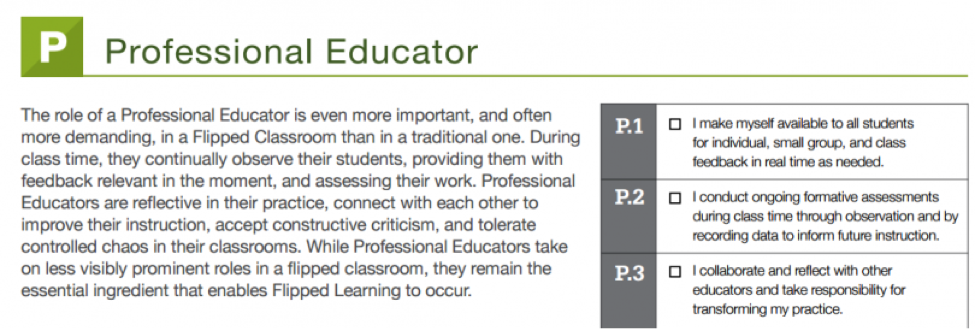
Flipped classroom is a "pedagogical approach in which straight didactics moves from the group learning infinite to the private learning space, and the resulting group space is transformed into a dynamic, interactive learning environment where the educator guides students as they utilize concepts and appoint creatively in the field of study matter" (The Flipped Learning Network, 2014).
The Four Pillars of F-L-I-P™
https://flippedlearning.org/wp-content/uploads/2016/07/FLIP_handout_FNL_Web.pdf
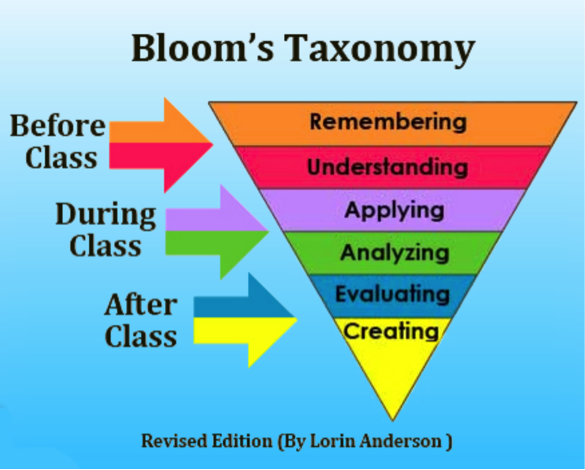
Fitting with the revised Bloom's Taxonomy
In traditional learning, lower level of learning such as remembering and understanding is happening in class, while students are usually left to work on activities that involve college level of learning exterior of classroom. However, in the flipped classroom model, learning is flipped. As y'all tin can encounter from the pyramid, students can finish the lower level of cognitive piece of work before class. And when they come to form, they can appoint in higher cognitive levels of learning with peers and teacher present.
Back to Top
Why yous should flip your classroom?
The concept of flipped classroom was start brought upwardly by Jonathan Bergmann and Aaron Sams, who were both high school chemistry teachers. In their book: Flip your classroom: Accomplish every student in every class every day (2012), they discussed a couple of reasons why teachers should consider flipping (p.20-33):
- Flipping speaks the linguistic communication of today'south students.
- Flipping helps busy students.
- Flipping helps struggling students.
- Flipping helps students of all abilities to excel.
- Flipping allows students to pause and rewind their instructor.
- Flipping increases educatee-teacher interaction.
- Flipping allows teachers to know their students meliorate.
- Flipping increases educatee-educatee interaction.
- Flipping allows for real differentiation.
- Flipping changes classroom management.
- Flipping changes the way we talk to parents.
- Flipping educate parents.
- Flipping makes your form transparent.
- Flipping is a great technique for absent teachers.
- Flipping can lead to the flipped mastery plan.
A sidebar in this book also cites 5 "bad reasons for flipping your classroom" (p.21). It is important for teachers to motility beyond these perceptions.
- Considering some guys who got a book published told you to.
- Considering yous recall information technology will create a 21st-centry classroom.
Pedagogy should e'er drive technology, never the other way around.
- Because you lot call back you will become cut border.
Flipping does not necessarily employ the latest technology.
- Because you lot recollect flipping your classroom exempts you from being a good teacher.
Teaching is much more than good content delivery.
- Considering you think it will make your job easier.
Flipping volition not make your task any easier.
Back to Tiptop
How to implement a flipped classroom?
Jeff Dunn (2014) has wrote a short slice on "The 6-footstep guide to flipping your classroom", which presented half-dozen easy steps for implementing flipped classroom.
- Plan
Figure out which lesson in detail you want to flip. Outline the primal learning outcomes and a lesson plan.
- Tape
Instead of education this lesson in-person, make a video. A screencast works. Make sure information technology contains all the key elements yous'd mention in the classroom.
In Bergmann and Sams' book (2012), they besides pointed out that exercise not make a video merely for the sake of making a video. But do so when you experience these are appropriate and necessary. It all depends on the educational goal of your lesson. If making videos ameliorate facilitate your instructional goal, then become ahead.
- Share
Send the video to your students. Make it engaging and clear. Explain that the video'southward content will be fully discussed in class.
- Change
Now that your students have viewed your lesson, they're prepared to actually go more than in-depth than always before.
- Group
An constructive fashion to discuss the topic is to split up into groups where students are given a task to perform. Write a poem, a play, make a video, etc.
- Regroup
Go the form dorsum together to share the individual group'due south work with everyone. Enquire questions, dive deeper than e'er earlier.
After the six steps, Review, Revise, and Repeat!
Some other strategies that can be used in in-course activities include:
- Active learning. Allow students to apply concepts in course where they can ask peers or instructors for feedback and clarification.
- Peer instruction. Students can teach each other by explaining concepts or working on small-scale bug.
- Collaborative learning. Collaborative learning activities could increase student appointment, heighten student agreement, and promote collective intelligence.
- Problem-based learning. Class fourth dimension can exist spent working on problems that tin last for the duration of a semester.
- Discussions or debate. Give students the opportunity to articulate their thoughts on the spot and to develop their arguments in back up of their opinions or claims.
Back to Height
What has recent enquiry on flipped classroom and medical education suggested?
A almost recent systematic review (Chen, Lui, and Martinelli, 2017) examined 46 articles on the effectiveness of flipped classrooms in medical pedagogy with dissimilar learning outcomes.
- The effect of flipped classroom
This review suggested inconsistent findings regarding the furnishings of flipped classroom in student learning, with some suggesting benefits while others reporting negligible improvement over traditional teaching methods.
- Perceptions of flipped classroom
"Students were generally satisfied with the approach, specially the usefulness of the online modules, because of easy access to resource for self-paced learning" (p.590).
- Attitude changes after using the flipped classroom
Positive changes were reported in this review study. Studies have suggested that medical students reported increased enjoyment, decreased boredom, and greater task value in flipped classroom.
- Knowledge, skills and behavior changes with the flipped classroom curriculum
Mixed results were detected regarding students' changes in cognition and skills with the flipped classroom versus the traditional lecturing. Similar to student learning consequence, some studies found positive results while others suggesting no differences.
This review further provided several suggestions for future inquiry. First, future enquiry in flipped classroom and medical education should try to have students' compliance with the flipped classroom requirement into business relationship. Other confounding variables may include fourth dimension spent in class, outside of class and in clinical work. 2d, hereafter research could examine the differences of flipped classroom on knowledge requiring dissimilar cognitive levels. Third, hereafter inquiry could apply alter in attitude as a moderator to examine the issue of flipped classroom on cognition conquering. Finally, students' knowledge retentions and transfer of knowledge to professional person practice would be worthy of test.
Back to Top
References
Bergmann, J., & Sams, A. (2012). Flip your classroom: Reach every student in every class every day. Eugene, Or: International Order for Engineering in Teaching.
Center for Pedagogy Innovation at Cornell Academy. (2017). Flipping the classroom. Retrieved from https://world wide web.cte.cornell.edu/teaching-ideas/designing-your-course/flipping-the-classroom.html.
Chen, F., Lui, A. M., & Martinelli, Southward. M. (2017). A systematic review of the effectiveness of flipped classrooms in medical teaching. Medical Education, 51(half-dozen), 585–597. https://doi.org/ten.1111/medu.13272
Dunn, J. (2014). The 6-stride guide to flipping your classroom. Retrieved from https://kitzu.org/flipped-classroom-model/
Flipped Learning Network (FLN). (2014) The Iv Pillars of F-L-I-P™
Source: https://omerad.msu.edu/teaching/teaching-skills-strategies/27-teaching/162-what-why-and-how-to-implement-a-flipped-classroom-model

Post a Comment for "How to Use a Flipped Classroom Model in High School Language Arts"